




Walk into any High-Mix, Low-Volume (HMLV) manufacturing facility, and the first thing you’ll likely see isn’t the finished product—it’s the clutter. Pallets of semi-finished metal components, half-assembled devices, and overflowing totes line the hallways. Plant managers often point to these crowded aisles as a sign of a “busy” and “productive” shop. In reality, they are looking at a visual representation of a liquidity crisis.
In the framework of Operational Excellence, a crowded hallway is the symptom of a sick operation. It is the physical evidence of Work-in-Progress (WIP) that has reached toxic levels. In HMLV environments, where complexity is high and batch sizes are small, excess WIP is literally kidnapped cash. It is capital that has been withdrawn from your bank account and frozen in a state where it cannot be invoiced, cannot be sold, and is constantly at risk of obsolescence.
The $2 Million Cost of “Busy-ness”
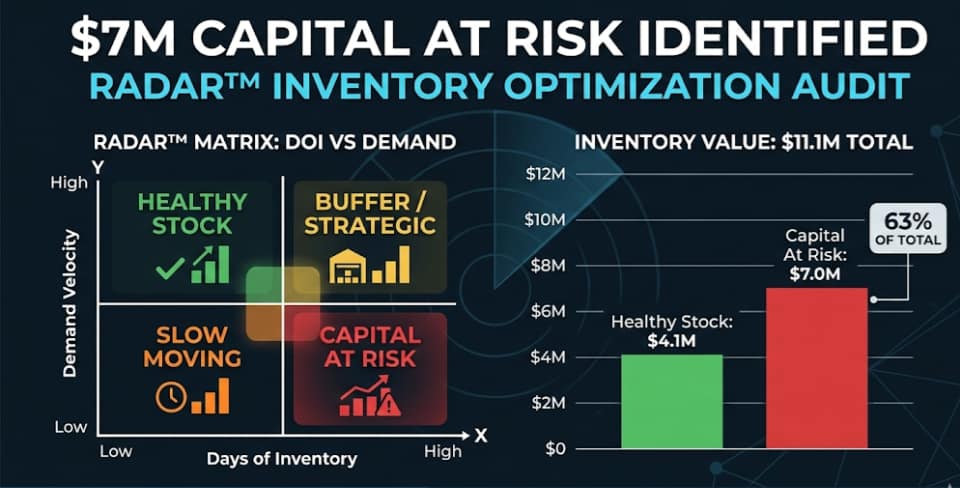
For a mid-sized precision machining or Food & Beverage (F&B) firm, the financial burden of excess WIP is staggering. A typical mid-sized OEM can easily have over $2.4 million immobilized in half-finished products that generate zero revenue. This isn’t just an “inventory problem”; it is a direct failure of the Cash Conversion Cycle (CCC).
According to the Bureau of Labor Statistics, while manufacturing sector labor productivity increased 2.5% in the second quarter of 2025, unit labor costs simultaneously rose by 2.0%. This productivity-cost gap is often widened by the “hidden” waste of high WIP. When cash is tied up in unfinished goods, your business loses the liquidity needed to invest in new contracts, bulk raw material discounts, or strategic technology. Furthermore, as noted by Deloitte, 78% of manufacturers are concerned about trade uncertainty and rising input costs, which are expected to increase by an average of 5.4%. In this environment, having $2 million “stuck in the hallways” is not just inefficient—it is an unacceptable risk to your solvency.
SMED: The Financial Engineering Lever
The root cause of “Kidnapped Cash” in your hallways is almost always setup time. In HMLV shops, the pressure to maintain “machine utilization” leads to a dangerous behavioral trap. If a production line changeover takes 3 hours, the manager will instinctively produce massive batches—far beyond the immediate customer demand—to “justify” the downtime of the setup.
This is where the SMED (Single-Minute Exchange of Die) methodology stops being just a Lean tool and starts being a financial engineering weapon. The goal of SMED is to reduce changeover times from hours to minutes, enabling smaller batch sizes and more frequent rotations.
The math is undeniable. Research published by MDPI regarding SMED implementation shows that reducing changeovers can lead to a potential reduction in stock by minimizing production batch sizes. In a recent industrial turnaround, reducing changeovers from 3 hours to 45 minutes slashed inventory levels by 42%, freeing up significant internal capital without a single dollar of new CapEx investment.
The CCC Impact: Turning Time into Liquidity
The primary objective of a UPKAIZEN turnaround is to shorten the distance between the last cent spent on raw materials and the first cent received from the customer. By using SMED to slash WIP, we directly impact the Cash Conversion Cycle.
In documented cases, the CCC has been reduced from 72 days to 46 days—a 26-day improvement. For a mid-sized firm, those 26 days of recovered liquidity translated into an annual cash flow improvement of $1.1 million.
This level of performance is exactly what we target in our Optimal 2026 framework. Achieving an OEE of 95.2% and a +30% Throughput YOY is impossible if you are overproducing to hide setup inefficiencies. High OEE in an HMLV environment is a result of flexibility, not sheer volume. To track this, we utilize the(https://www.wallstreetprep.com/knowledge/demystifying-the-13-week-cash-flow-model-in-excel/) model, which connects inventory roll-forward schedules directly to weekly liquidity forecasts.
The UPKAIZEN Rules for WIP Management
To stop the cash bleed in your hallways, you must enforce three non-negotiable rules of Operational Excellence:
1. Constraint Flow (Lining up the Cash)
Implement forced inventory limits between processes. This “System Pull” logic forces the organization to acknowledge and fix the bottleneck instead of burying it in inventory. As highlighted by McKinsey, successful large-scale transformations require rigorous impact tracking andgovernance to ensure localized problems don’t paralyze the entire network.
2. Flexibility Over Volume
Prioritize machines and processes that can change fast over those that simply run fast. The competitive advantage in 2026 belongs to the manufacturer who can switch between complex SKUs in 10 minutes, thereby releasing working capital that would otherwise be trapped in slow-moving finished goods.
3. Visibility is Solvency
WIP is a balance sheet item managed on the factory floor. If your WIP levels are rising, your liquidity is falling. We implement real-time tracking to measure the OEE formula—Availability, Performance, and Quality—ensuring that “Speed Losses” are not masquerading as “Productivity”.
Conclusion: Stop Measuring “Busy-ness,” Start Measuring Cash
“Deck-only” consultants will tell you that you need a multi-million dollar ERP upgrade to fix your inventory. At UPKAIZEN, we know the truth is simpler and more hands-on. Your cash is sitting in your hallways because your setup times are too long and your batch sizes are too big.
To achieve Optimal 2026 results, you must bridge the gap between industrial engineering and financial management. Stop commissioning reports that only diagnose symptoms. Start driving liquidity from the floor by attacking setup times and freeing your kidnapped cash.
Ready to Unlock the $2 Million Hidden in Your Hallways?
Don’t let your liquidity evaporate in the form of unneeded inventory. UPKAIZEN provides the hands-on turnaround expertise to turn your HMLV complexity into a competitive advantage.
- Release your Working Capital: Explore our services to shorten your cash conversion cycle.
- Fix your Flow: Discover how Business Operations Management can eliminate the bottlenecks hiding in your halls.
- Train your Execution Team: Schedule a meeting to build a shop floor culture that understands OEE and SMED.
Contact UPKAIZEN today to begin your 90-day roadmap to industrial and financial excellence.
