

The Challenge: The “Inventory Blindness”
A food manufacturing company with a portfolio of 300 SKUs faced a critical paradox: historically high inventory levels occurring simultaneously with recurring cash flow tensions.
Traditional analysis (ABC by revenue) suggested that stock was “under control.” However, the financial reality told a different story. The executive team needed to answer a decisive question: How much of our cash is actually “sleeping” in the warehouse, and what is the opportunity cost?
The Solution: RADAR™ Inventory Scan
Instead of viewing inventory as a static accounting figure, we deployed a Business Intelligence framework that synchronizes two vital operational dimensions:
- Demand Volume & Velocity.
- Days of Inventory (DOI) real-time aging.
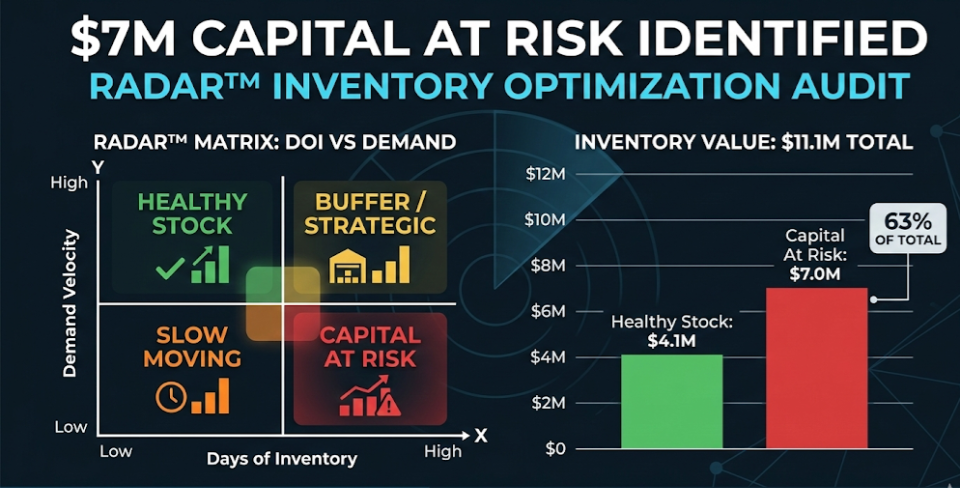
By integrating these variables into our RADAR™ environment, we achieved an automated segmentation that isolates “Healthy Stock” from “Capital at Risk.” This goes beyond what any standard ERP can visualize.
Executive Insights: Financial Impact
1. Macro Diagnosis: Identifying Capital Leakage
Through RADAR™ Scan, the system exposed a figure hidden by traditional spreadsheets: out of a total inventory of $11M, $7M (63%) was identified as Capital at Risk (Inmobilized).
2. From Visibility to Immediate Liquidity
This level of granular visibility allowed the Procurement Department to halt unnecessary orders instantly. Managers were able to navigate from the $7M global leak down to the specific SKU level in just three clicks.
The system pinpointed exactly which high-inventory products required immediate action—be it promotional liquidation, supply recalibration, or strategic write-offs—to clean the warehouse and restore the balance sheet.
Strategic Outcomes
- Total Visibility: Transitioned from static monthly reports to a daily monitor of working capital that traditional ERPs fail to detect.
- Leakage Identification: Precise localization of $7M ready to be converted back into liquidity.
- Decisive Governance: Drastic reduction of human bias in purchasing and SKU rationalization.
- Operational Cleanliness: Execution of write-offs and warehouse optimization based on financial data, not intuition.
Conclusion
Business Intelligence is not about “viewing the past”; it’s about commanding the future of your cash flow. In this case, the use of dynamic matrices allowed the organization to transform a storage liability into a reinvestment opportunity.
Ready to unlock your trapped cash flow?
Don’t let your working capital sleep in the warehouse. Activate your RADAR™ Scan EBITDA Recovery Audit today and identify exactly where your liquidity is hiding.
Click here to Start your RADAR™ Scan
Not ready for a scan? Join our newsletter