

Executive Summary
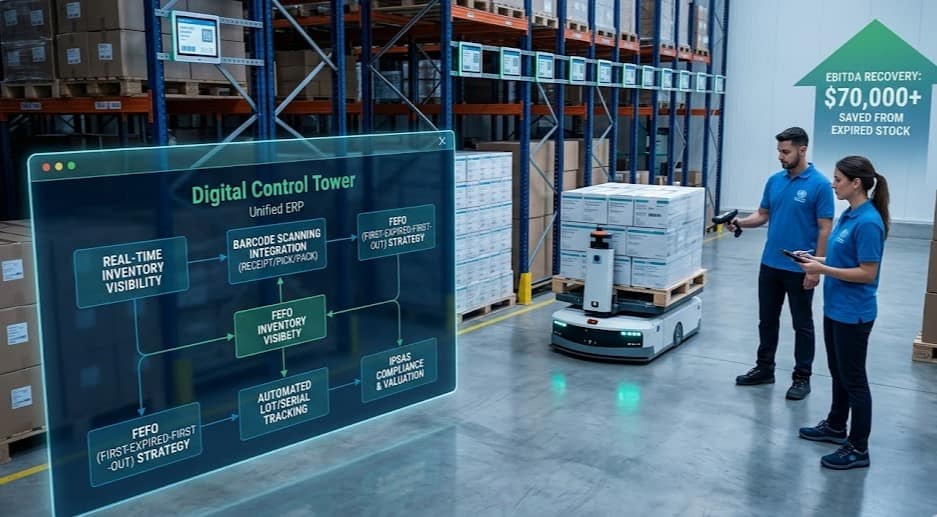
A leading international health organization faced significant operational bottlenecks due to fragmented inventory management across multiple regional offices. Manual data entry, disparate stock control systems, and a lack of real-time visibility led to over $70,000 in losses from expired critical medical supplies. By implementing a unified, automated Enterprise Resource Planning (ERP) solution, the organization achieved end-to-end traceability, real-time inventory valuation, and standardized operational procedures.
The Challenge: Fragmented Operations & Financial Leakage
Before the digital intervention, the organization struggled with several critical logistical hurdles:
- System Disparity: Four separate departments operated individual stock control systems with no real-time synchronization.
- Data Accuracy & Duplication: Reliance on static systems led to the constant re-recording of data and manual measurement errors.
- Critical Supply Losses: Poor recording and ordering processes resulted in a failure to monitor expiration dates, leading to substantial financial waste on vital health items.
- The “Last Mile” Blind Spot: There was no formal receipt system for items arriving at Country Offices (COs), meaning supplies were often “lost” in the final step of delivery.
The Strategy: Implementing Industrial Engineering Rigor
The transformation strategy focused on moving from a reactive to a proactive supply chain model by integrating a modern Warehouse Management System (WMS).
1. Unified Real-Time Inventory
The organization transitioned to a double-entry inventory system, ensuring that every product movement—from supplier to end-user—was fully traceable. This eliminated “static” data in favor of a dynamic, automated dashboard.
2. Advanced Traceability & Automation
- Barcode Integration: Implementing mobile barcode scanning for receipts, packing, and delivery removed the need for manual data entry and reduced human error.
- Automated Expiration Tracking: The system was configured to automatically track manufacturer lots and expiration dates, triggering alerts before items became unusable.
- Smart Replenishment: Using forecast tools and “burn rate” analysis, the system now automatically triggers requests for quotations based on future needs and minimum stock levels.
3. Standardized Compliance
To guarantee transparency and accountability, the system was aligned with IPSAS (International Public Sector Accounting Standards). This ensured that inventory valuation—including landed costs—was reflected accurately on the balance sheet in real-time.
Results & Impact
The shift to a standardized, integrated digital platform delivered immediate ROI:
- Elimination of Waste: Automated tracking and removal strategies (FIFO/FEFO) virtually eliminated losses from expired medical stock.
- Operational Transparency: Global leadership gained a “control tower” view of all regional warehouses, allowing for collaborative replenishment between offices.
- Efficient Resource Allocation: Automating import/export documentation and proof of delivery allowed human resources to focus on high-value logistics tasks rather than manual data entry.
- End-to-End Accountability: The organization established a “Receipt System” for Country Offices, ensuring 100% data accuracy from procurement to final health community delivery.
Conclusion
By applying industrial engineering principles and operational rigor, this global health entity successfully recovered its EBITDA (operational margin) by stopping profit leaks caused by systemic inefficiency. The transformation highlights how digital tools can turn a fragmented logistics network into a resilient, transparent, and life-saving supply chain.
Ready to unlock your trapped cash flow?
Don’t let your working capital sleep in the warehouse. Activate your RADAR™ Scan: EBITDA Recovery Audit today and identify exactly where your liquidity is hiding.
Click here to Start your RADAR™ Scan
Not ready for a scan? Join our newsletter to get operational insights.