


In high-growth business environments, supply chain friction scales faster than revenue. When digital commerce surges, legacy fulfillment frameworks designed for traditional store replenishment quickly turn into operational bottlenecks.
This case study breaks down the operational approach used by UPKAIZEN to transition a retail client from a vulnerable, centralized distribution model to an optimized, highly resilient Omnichannel retail strategy network.
The Operational Challenge & Core Bottlenecks
The client’s legacy network relied exclusively on two central Distribution Centers (DCs) to absorb the entire e-commerce and mobile order volume. As transaction frequency escalated, the operation faced severe pain points:
- Fulfillment Saturation: Centralized warehouses reached physical capacity limits, driving up internal processing friction and operational costs.
- Transit Inefficiencies: Parcels routinely traversed long shipping distances across the carrier network, drastically inflating freight costs and creating an over-reliance on expedited air services to hit delivery deadlines.
- Data Integrity Deficits: Historical shipping databases contained critical anomalies regarding weight inputs, invalid postal codes, and unoptimized routing selections, creating a distorted operational baseline.
The UPKAIZEN Solution: A Lean Network Shift
To address these challenges, UPKAIZEN designed a dynamic network optimization model to minimize total logistics expenses under strict, real-world operational constraints:
- Data Clean-Up: Programmatically audited and sanitized the historical shipping database to eliminate data anomalies and establish a true cost baseline.
- Capillary Redesign: Evaluated transit times from all retail stores and central DCs simultaneously per order to find the nearest and most cost-effective shipping node.
- Capacity Balancing: Systematically routed order volumes to the closest local stores while enforcing a strict capacity ceiling per store to protect walk-in retail operations and avoid workplace saturation.
Proven Operational ROI
By replacing centralized inertia with capillary efficiency, the final omnichannel optimization model delivered immediate financial and operational recovery:
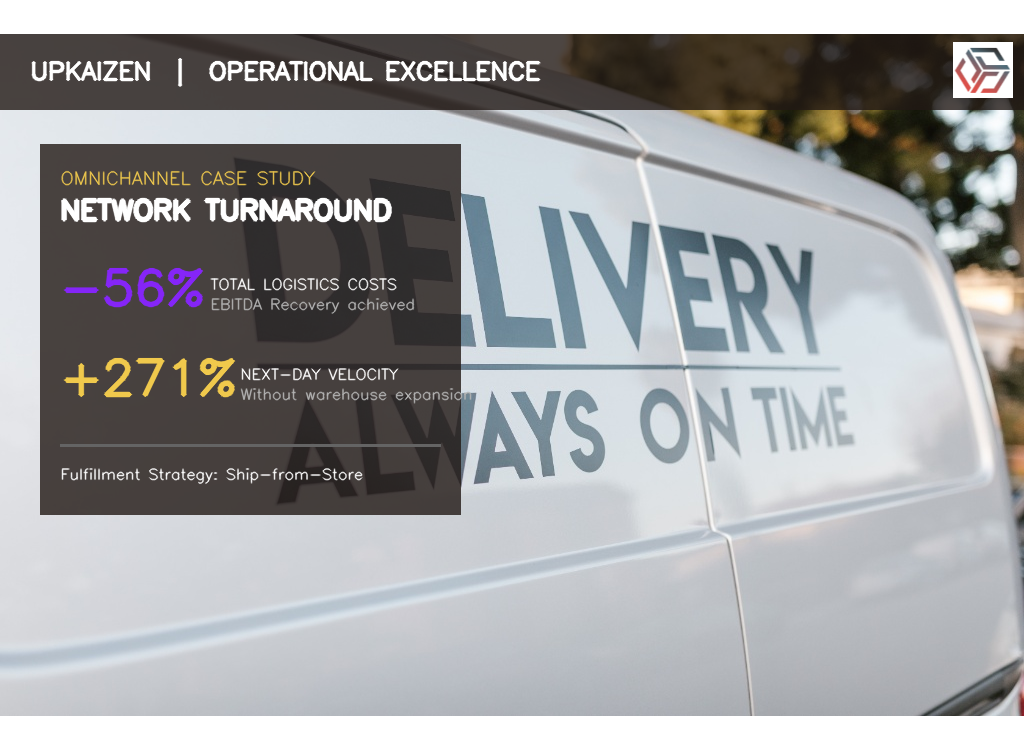
- Total Logistics Cost: Reduced by -56% (surpassing the 50% objective).
- Freight & Transportation Cost: Reduced by -60% (surpassing the 55% objective).
- Service Level Index: Achieved a +271% increase in Next-Business-Day deliveries.
- Premium Freight Elimination: Bypassed expensive priority overnight air freights completely. The optimized network fulfilled 100% of orders within a 48-hour window using only lower-cost standard ground services, while compressing maximum transit distances down to Zone 4.
Strategic Conclusion
Operational velocity and structural network design are the ultimate drivers of corporate cash flow resilience and margin protection. As emphasized in global research on Deloitte’s Supply Chain Resilience framework, companies that master localized node capacity and agile fulfillment logistics achieve far greater cost stability and operational readiness during sudden demand surges. By transforming decentralized storefronts into high-performing shipping nodes, UPKAIZEN proved that a lean supply chain doesn’t just cut costs—it redefines market responsiveness.
Ready to unlock your trapped cash flow?
Don’t let your working capital sleep in the warehouse. Activate your RADAR™ Scan: EBITDA Recovery Audit today and identify exactly where your liquidity is hiding.
👉 Start my RADAR™ Scan (Vinculado directo a la herramienta/formulario del diagnóstico)
Not ready for a scan? Join our newsletter to get operational insights.